Collider

How a collider works

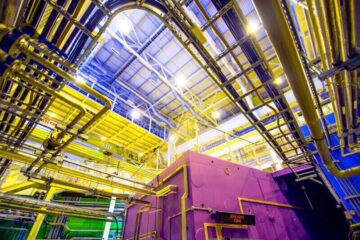
Colliders have two functions, to accelerate particles to high speeds in beams about 2mm wide (small enough to pass through the 0 on a 20 pence piece) and to then direct the beams to collide head-on at the collision points at the heart of the detectors.

The LHC is the world’s most powerful particle accelerator and will create collision energies 7x greater than previous machines.

The particles the LHC will accelerate and collide are protons or lead nuclei, both have positive charges and this means that they can be steered by use of appropriate magnetic fields.

Various types of superconducting magnets (9,300 in total) are used to steer and focus beams of particles as they race around the 27km loop of the LHC collider. The LHC carries two beams, travelling in opposite directions, in two, adjacent beam pipes. At the collision points the beams briefly share the same pipe as the magnets direct them to collide head-on. The beam pipes are enclosed in a sheath of superconducting magnets and all of this is bathed in supercold liquid helium (1.8oK).

The magnets, which make up the bulk of the collider, are only one part of the story. The other task of the collider is to accelerate the particles as they travel around it. This is done at 4 locations where the particles pass through superconducting radio frequency (RF) cavities. Just like pushing a child’s swing, these RF cavities give the particles a push each time they pass, steadily increasing the energy of the particles prior to collision.

The LHC is the last in a ‘ladder’ of accelerators that are used in sequence to accelerate low energy particles up to the LHC’s maximum energy.

More on the collider, LHC outreach pages on the CERN website.