Who's hidden all the antimatter?

Why is there a matter universe?

Our best theories for the origin of the Universe estimate it began 13.7 billion years ago as an infinitely hot and infinitely dense ball of energy. In those first instants of time, the universe expanded and cooled. All the particles we observe today, and the interactions between them, condensed into existence in those early seconds and minutes.

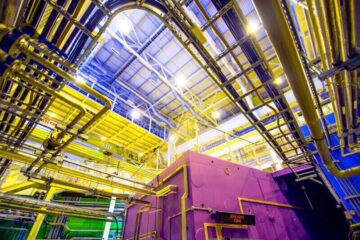
A view along a section of the 27km long LHC tunnel and collider A view along a section of the 27km long LHC tunnel and collider

If this Big Bang theory is right, antimatter and matter should have been created in equal amounts. Each matter particle should have an antiparticle. This poses an obvious problem, as matter and antimatter annihilate on contact, so you'd expect the universe to just be energy. Or equal parts matter and antimatter, not touching. But it isn't. Somehow, some tiny asymmetry between matter and antimatter allowed matter to get the upper hand, leading to the matter universe we're in.

Getting to the bottom of this mystery is a deep problem in physics. It just doesn't add up, which usually means we've made a wrong turn somewhere - but where?

For this assignment, you will research the latest scientific thinking about antimatter and how the experiments at the LHC might crack this profound puzzle. Your teacher will tell you how they would like you to present your findings.

Key things to find out:

  • What is antimatter?
  • Who came up with the idea of antimatter, and when?
  • Has anybody made antimatter?
  • Why is the LHCb (Large Hadron Collider beauty) experiment using b-quarks and anti-b-quarks to look for differences between matter and antimatter?
  • Could antimatter be used as a power source? Or to make a bomb?

Useful online references:


© 2012 Science and Technology Facilities Council - All Rights Reserved.